

As an Amazon Associate I earn from qualifying purchases. Product links on this page may be affiliate links.
Last Updated on 2026-07-06
Yes, in most homes, guppies need a heater. While guppies are hardy and can survive in a wide range of temperatures, they are tropical fish that only thrive in a stable temperature range of 72-82°F (22-28°C). A heater is the only way to guarantee this stable warmth, preventing stress and protecting them from common diseases like Ich and Fin Rot.
Temperature Zones: Understanding What Guppies Need
| Temperature Range | Effect on Guppies |
|---|---|
| Ideal: 72-82°F (22-28°C) | Active, Colorful, Healthy, Breeding |
| Tolerable: 68-72°F (20-22°C) | Surviving but not thriving; lethargic, prone to illness |
| Dangerous: Below 68°F (20°C) | Severe stress, clamped fins, high risk of disease and death |
Even though guppies are marketed as “hardy” beginner fish, this hardiness is relative. It means they can tolerate occasional temperature fluctuations better than sensitive species like discus fish. However, hardiness does not mean they can thrive without proper temperature. In cold water, your guppies won’t flourish—they’ll merely survive, and often poorly.
The Dangers of Keeping Guppies in Cold Water

Understanding what happens when guppies live in temperatures below their ideal range is crucial for any prospective owner.
Lethargy and Inactivity
In cold water, a guppy’s metabolism slows down drastically. You’ve likely heard that cold-blooded animals depend on their environment for body temperature—this is exactly what happens. When water is cold, your guppies will become listless and inactive. They’ll spend most of their time hiding at the bottom of the tank, rarely exploring or interacting with their environment. Their interest in food will plummet, and they’ll eat less frequently, leading to weight loss and weakened condition.
This behavior change is not just unattractive to watch—it’s a sign of serious stress. Your guppies aren’t happy; they’re struggling to function.
Weakened Immune System and Disease
This is the most critical concern. Temperature stress is a primary trigger for diseases like Ich (White Spot Disease), Fin Rot, and bacterial infections. When guppies live in cold water, their immune systems cannot function properly. Their white blood cells move and respond more slowly, leaving them vulnerable to pathogens that would normally be harmless.
Even if your tank water quality is perfect, a cold temperature makes disease almost inevitable. You might notice white spots on your guppies’ bodies (Ich), torn or deteriorating fins (Fin Rot), or unusual sores. These conditions develop rapidly in cold water because the guppies lack the immune response needed to fight back.
Treating these diseases with medication is possible, but it’s stressful for the fish and often expensive. Prevention through proper temperature is infinitely easier.
Dull Colors and Stunted Growth
One of the reasons guppies are so popular is their spectacular, iridescent colors—brilliant reds, blues, yellows, and metallic sheens. In cold water, these colors fade dramatically. Your guppies will look dull, washed-out, and unrecognizable compared to healthy, warm-water guppies.
If you’re breeding guppies or have young fry, cold water is especially harmful. Juvenile guppies will experience stunted growth and fail to develop their full coloration. What should be a vibrant 3-month-old guppy will look like a pale, tiny version of itself. For more on raising healthy babies, check out our guide on how to care for guppy fry.
The Benefits of a Heated, Stable Tank
When you provide the proper temperature, the transformation in your guppies is remarkable.
Increased Activity and Vibrant Colors
Warm water keeps their metabolism active and thriving. Your guppies will be constantly exploring the tank, displaying natural behaviors like foraging, social interaction, and fin displays. The vibrant colors you see in store-bought guppies will emerge and intensify in your tank.
Males will display their full fin spread, and females will develop rounder, healthier bodies. It’s genuinely rewarding to watch active, colorful guppies thrive in your care.
Encourages Breeding
If you’re interested in breeding guppies, a warm, stable temperature is essential. The ideal temperature range is a key trigger for guppies to enter breeding mode. In cold water, they won’t breed at all. In warm water, they’ll reproduce prolifically—sometimes too prolifically, so be prepared!
Prevents Temperature Swings
The primary job of a heater is not just to raise temperature—it’s to provide stability. Water temperature naturally fluctuates with room temperature, time of day, and season. Your guppies are stressed by sudden changes, even if the average temperature seems acceptable.
Consider a typical scenario: your living room is 70°F during the day, but at night it drops to 60°F. Without a heater, your tank water will follow that same drop. Your guppies experience this nightly shock to their system repeatedly, causing chronic stress that weakens their immune system over weeks.
A heater prevents these dangerous swings. It maintains a steady 75°F day and night, year-round. This stability is as important as the actual temperature itself.
How to Choose the Right Heater for Your Guppy Tank
If you’ve decided a heater is necessary—and for most people, it is—here’s how to select the right one.
The Importance of an Adjustable Thermostat
Never buy a fixed-temperature heater. Always choose an adjustable heater with a built-in thermostat. This is essential. A thermostat automatically turns the heater on and off to maintain your set temperature, preventing both chilling and overheating.
Fixed-temperature heaters have no control mechanism. They’ll heat your tank to their preset temperature regardless of room conditions, and there’s no way to adjust it. In summer, your tank could overheat dangerously. Avoid this risk entirely by investing in a thermostat-controlled model.
What Wattage Do You Need?
Wattage depends on your tank size and the temperature difference between your room and your desired tank temperature. Use this basic guide:
5-10 Gallon Tank: 25-50 watts
20 Gallon Tank: 75-100 watts
30-40 Gallon Tank: 100-150 watts
If your room temperature is already close to 72°F, aim for the lower end of the wattage range. If your room is much colder (as in basements or winter months), choose the higher wattage to ensure the heater can maintain temperature without running constantly. You can see our top recommendations in our article on the Best Aquarium Heaters.
Don’t Forget the Thermometer!
Here’s a critical point many beginners overlook: a heater is useless without a reliable thermometer. You need a separate, accurate thermometer to verify the water temperature. Many heater thermostats are inaccurate, especially cheaper models. By comparing the heater’s reading with a separate thermometer, you can catch discrepancies and adjust accordingly.
Invest in a quality analog or digital thermometer. It’s inexpensive insurance against temperature errors.
Our Top Heater Recommendations for Guppy Tanks
To make your choice easier, here are three reliable, adjustable heaters available on Amazon that are perfect for guppy tanks ranging from 5 to 15 gallons.
1. Best Overall: Hygger 50W Submersible Aquarium Heater
This is a fantastic all-around choice for beginners. The Hygger submersible heater is fully adjustable and features an external digital controller, so you can set the temperature without getting your hands wet. Its built-in thermometer is easy to read, and it has an excellent reputation for reliability and maintaining a stable temperature. The 50-watt version is perfect for 5-15 gallon tanks.
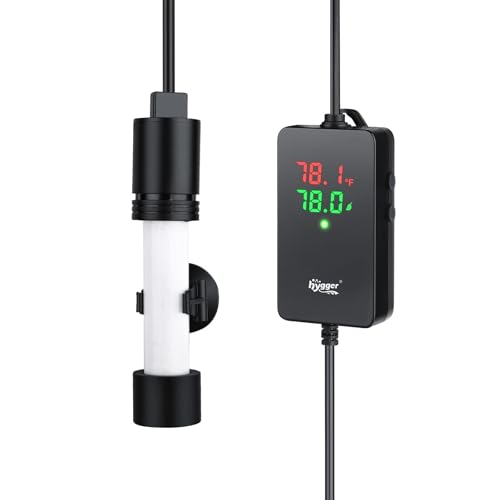
hygger ECO Precise Aquarium Submersible Heater, 50W for 5-100 Gallon Fish Tank Heater with Digital Display Adjustable Controller for Saltwater Freshwater
- Safety Beep Alarm: Designed with temperature probe fault, out-of-water fault, and overheat protection to remind you to check your fish tank, enhance…
2. Premium Choice: Fluval M50 Submersible Heater
If you’re willing to invest a little more for a top-tier brand, you can’t go wrong with Fluval. The M-series heaters are renowned in the aquarium hobby for their durability and quality construction. It features a simple-to-use dial for temperature adjustment and a shock-resistant glass design. This is a workhorse heater that will provide peace of mind for years. The 50-watt model is ideal for tanks up to 15 gallons.
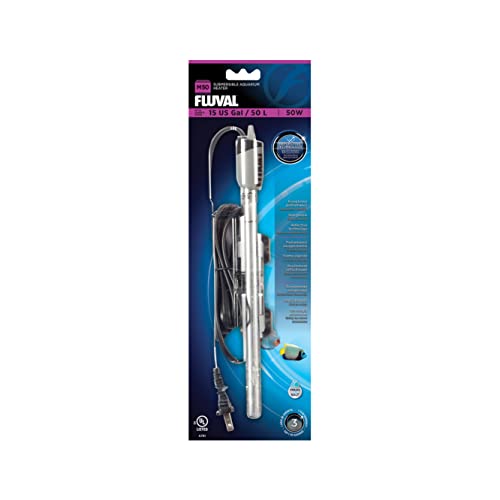
Fluval M 50-Watt Submersible Aquarium Heater for Fresh & Saltwater Tanks
- Precision Temperature Control: The Fluval M 50-Watt Submersible Heater features a computer-calibrated thermostat for consistent, accurate heating. Th…
- Reflective Mirror Technology: Designed to seamlessly blend into your aquarium, this heater uses built-in reflective technology that mirrors surroundi…
- Durable & Safe Materials: Constructed with shock-resistant Borosilicate glass and a high-density ceramic heat sink, this heater is built to withstand…
3. Best for Small Tanks: AQQA 50W Mini Aquarium Heater
For those with smaller 5-gallon tanks where space is tight, the AQQA Mini is an excellent option. Its compact, flat profile takes up very little room. Like the Hygger, it has an external controller for easy temperature setting and a clear LED display. It’s a very popular and highly-rated choice for nano and small aquarium owners who need a reliable, adjustable heater without the bulk.

AQQA Submersible Aquarium Heater with Dual Display & Safety Protection 25W
- Trusted AQQA Aquarium Heater: Protective case made of corrosion-resistant bear high temperature materials; High purity nickel wire rapid heating; Exp…
- Set Temperature 59℉-93℉: The temperature can be recurring set by pressing the button,increase by 1℃ /1 ℉ each; Press and hold for 8 seconds to conver…
- Out Of Water Power Off: When the heater leaves the water surface 2.4 inch, automatic power off and error code E1, re-immersed completely in the water…
The Exception: Can You Keep Guppies Without a Heater?
It’s technically possible, but only under very specific conditions. You can skip the heater only if your ambient room temperature never drops below 72°F (22°C), day or night, year-round. This includes accounting for seasonal changes and nighttime temperature drops.
For most people in North America and Europe, this is simply not realistic. Winter heating systems don’t run 24/7 in bedrooms and basements. Air conditioning in summer can drop temperatures unexpectedly. Even in warm climates, nighttime brings cooler temperatures.
A heater is a cheap and essential “insurance policy” for your fish’s health. Quality aquarium heaters cost $20-50 and last years. Compare that to the ongoing costs of treating sick guppies or replacing fish that succumb to cold-related illness, and a heater becomes one of the best purchases you’ll make for your tank.
Signs Your Guppies Are Too Cold
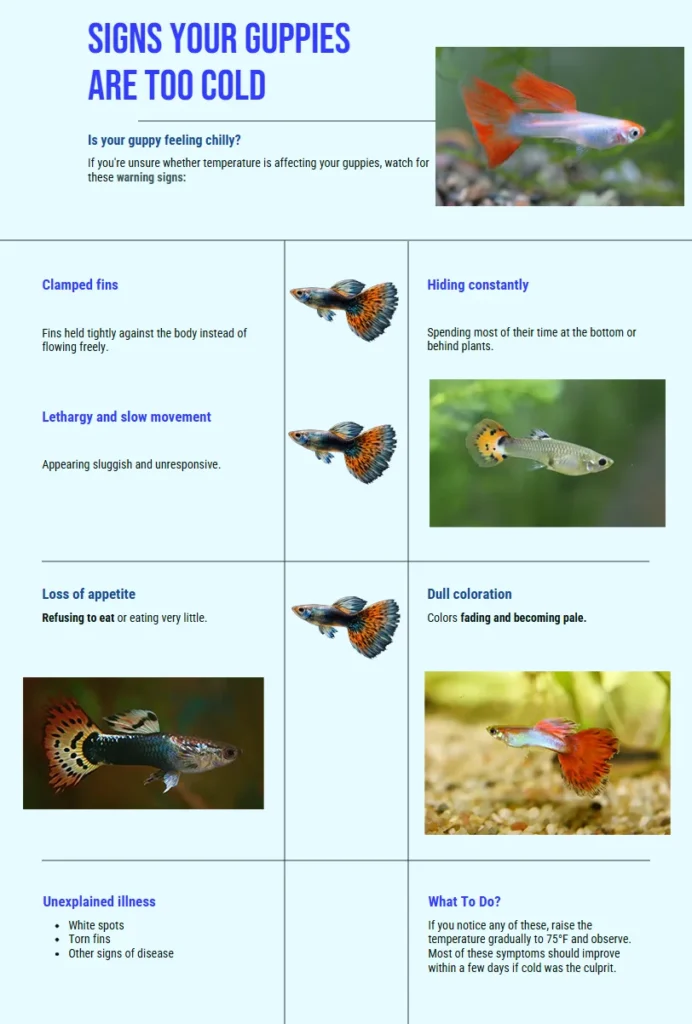
If you’re unsure whether temperature is affecting your guppies, watch for these warning signs:
- Clamped fins: Fins held tightly against the body instead of flowing freely
- Hiding constantly: Spending most of their time at the bottom or behind plants
- Lethargy and slow movement: Appearing sluggish and unresponsive
- Loss of appetite: Refusing to eat or eating very little
- Dull coloration: Colors fading and becoming pale
- Unexplained illness: White spots, torn fins, or other signs of disease
If you notice any of these, raise the temperature gradually to 75°F and observe. Most of these symptoms should improve within a few days if cold was the culprit.
For more help, take a look at our article on whether guppies sleep.
Frequently Asked Questions
What is the best temperature for guppies?
The ideal range is 72-82°F (22-28°C), with 75-78°F being optimal for most situations. This temperature range keeps them active, colorful, and healthy.
Can guppies survive in a 60-degree tank?
No. 60°F is dangerously cold and will likely lead to severe illness or death. Guppies may survive a few days at this temperature, but they’ll succumb to disease quickly.
Will a heater make my tank too hot in the summer?
Not if it has a thermostat. A thermostat-controlled heater will simply turn off when the tank reaches the set temperature. It won’t overheat your tank.
How can I tell if my guppies are too cold?
Clamped fins, hiding behavior, lethargy, staying at the bottom, loss of appetite, and dull colors are all signs of temperature stress. If you see these symptoms, increase the temperature.
How long does it take for a heater to warm a tank?
It depends on the tank size and wattage, but typically 25-50 watts will raise a 10-gallon tank by 5°F in 1-2 hours. Plan ahead and set up your heater before adding guppies.
Do I need a heater in tropical climates?
Even in warm climates, a heater is beneficial because it prevents temperature swings at night and ensures stability. However, if your room temperature never drops below 72°F, you have more flexibility. Read more about why tropical fish need heaters even in warm homes.
The Bottom Line
Guppies need a heater in virtually all home environments. They are tropical fish that thrive in warm, stable water. Without a heater, you’re rolling the dice with your fish’s health. The small cost and effort of installing a quality, adjustable heater with a thermostat will reward you with active, colorful, healthy guppies that live their full lifespan.
Don’t let anyone convince you that guppies are “hardy enough” to skip this essential equipment. True guppy care means providing the conditions they need to thrive, not just barely survive.
About the author
