

Last Updated on 2026-07-06
Neon Tetras are remarkably hardy fish, but temperature fluctuations are their #1 killer. Whether you’re a new owner or planning to add these stunning South American natives to your aquarium, understanding their temperature needs is absolutely crucial for their survival and wellbeing.
⚡ Quick Answer: The ideal temperature for Neon Tetras is 72°F to 78°F (22°C – 26°C). For breeding, maintain slightly warmer water between 75°F and 78°F (24°C – 26°C). A quality aquarium heater is essential to maintain this stable temperature range.
In this comprehensive guide, you’ll discover everything you need to know about Neon Tetra temperature requirements, why a heater is non-negotiable, how to recognize temperature stress, and what to do in emergencies. Let’s ensure your tetras thrive!
Key Takeaways:
- Neon Tetras require a specific temperature range to thrive: 72-78°F (22-26°C) for general care and 75–78°F (24–26°C) for breeding
- A quality aquarium heater is essential – even in warm climates, nighttime temperature drops can be fatal
- Temperature stability matters more than hitting an exact number – sudden fluctuations cause stress and disease
- Both cold water (<70°F/21°C) and hot water (>80°F/27°C) create serious health problems
- Digital thermometers with alerts provide the best monitoring and early warning system
- Emergency heating methods can save your tetras when equipment fails
The Ideal Water Parameters for Neon Tetras
Given their origin in the warm waters of South America’s Amazon Basin, Neon Tetras have evolved to require specific water conditions to thrive. Understanding these parameters helps you create the perfect environment for these beautiful fish.
| Parameter | Ideal Range | Critical Notes |
|---|---|---|
| Temperature (General) | 72°F – 78°F (22°C – 26°C) | Must remain stable |
| Temperature (Breeding) | 75°F – 78°F (24°C – 26°C) | Warmer promotes spawning |
| pH Level | 6.0 – 7.0 | Slightly acidic preferred |
| Water Hardness | Soft (1-2 dGH) | Mimics natural habitat |
| Ammonia/Nitrite | 0 ppm | Non-negotiable |
| Nitrate | <20 ppm | Keep as low as possible |
Why Temperature Matters So Much
In their natural Amazon habitat, Neon Tetras inhabit slow-moving streams and tributaries where water temperatures remain consistently warm year-round. These fish have no biological mechanisms to adapt to cold water – their metabolism, immune system, and all bodily functions are calibrated for tropical conditions.
While temperature changes do occur naturally in the wild, they happen gradually over weeks and months with seasonal patterns. The rapid, drastic temperature swings that can occur in home aquariums – especially those without proper heating – cause extreme stress that weakens their immune systems and makes them susceptible to fatal diseases.
Temperature consistency matters more than hitting an exact number. A tank that maintains a steady 73°F (23°C) is far better than one that fluctuates between 70°F and 78°F (21°C – 26°C) throughout the day.
Do Neon Tetras Need a Heater?
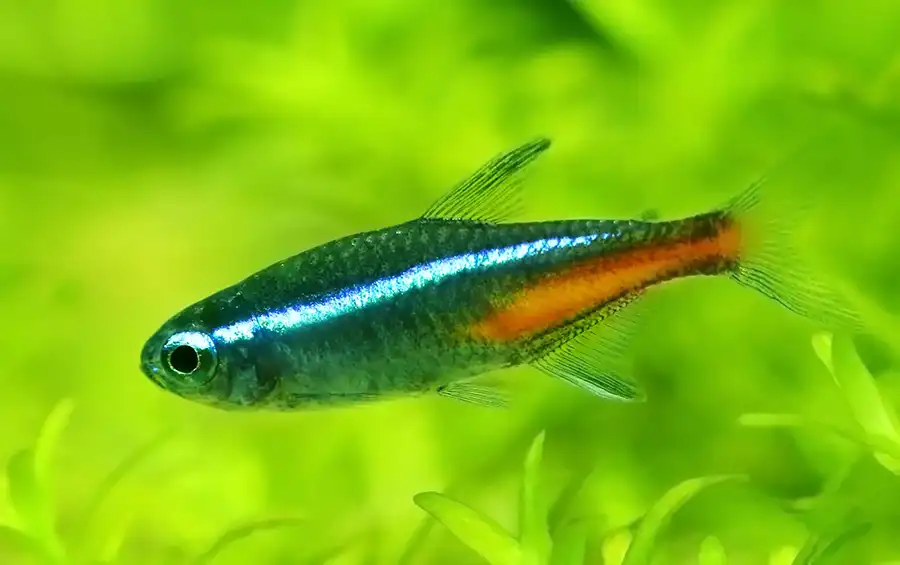
Yes, absolutely. When keeping tropical fish like Neon Tetras, a quality aquarium heater is not optional – it’s essential life-support equipment.
You should always add a heater to your tank when keeping Neon Tetras. They need a consistent temperature between 72-78°F (22-26°C). Even if you live in a warm climate where daytime temperatures reach the ideal range, a heater ensures the temperature never drops too low during cooler nights or air conditioning cycles.
One of the most important tools for Neon Tetra temperature management is a reliable aquarium heater. These are tropical fish that evolved in consistently warm water, and while your aquarium may reach the desired temperature range during peak daylight hours, “most of the time” simply isn’t enough for these sensitive fish.
Without a heater, your tank temperature will fluctuate with room temperature – dropping at night when heating systems cycle off, during cold weather, or when air conditioning runs. These fluctuations, even within what seems like a reasonable range, create chronic stress that shortens lifespan and invites disease.
How to Choose the Right Heater for Your Neon Tetras
The market offers numerous heater options, and choosing correctly matters significantly. Different heaters provide different wattages designed for specific tank sizes, and selecting the appropriate power level is crucial for maintaining stable temperatures.
Heater Wattage Guide
As a general rule, you should have between 2.5 and 5 watts per gallon of water. Here’s a quick reference guide:
| Tank Size | Recommended Wattage | Notes |
|---|---|---|
| 5 Gallon | 25-50 Watts | 50W for cold rooms |
| 10 Gallon | 50 Watts | Standard setup |
| 20 Gallon | 100 Watts | Or two 50W heaters |
| 30 Gallon | 150 Watts | Dual heaters recommended |
| 40+ Gallon | 200+ Watts | Always use dual heaters |
When purchasing your heater, ensure you research thoroughly to verify you’re selecting the correct wattage for your specific tank size and room conditions.
Adjustable vs. Preset Heaters
Recommendation: Choose adjustable heaters. While preset heaters cost less initially, adjustable models provide critical flexibility:
- Adjustable heaters let you fine-tune temperature for breeding, treat diseases with elevated temperatures, or compensate for room temperature changes. They’re worth the modest additional cost.
- Preset heaters maintain one fixed temperature (usually 78°F/26°C) with no adjustment capability. They work for basic setups but limit your options.
Critical Heater Placement
Position your heater near your filter output to distribute heated water evenly throughout the tank. This prevents hot spots near the heater and cold zones in distant corners. Horizontal placement typically provides better heat distribution than vertical positioning.
Important Safety Considerations
Once you’ve chosen your heater, understand its operation completely:
- Some heaters automatically shut off when removed from water – crucial to know during tank maintenance
- Never power on a heater outside of water – it will overheat and crack or explode
- Allow heaters to cool for 10-15 minutes after unplugging before removing from water
- Inspect heaters monthly for cracks, mineral buildup, or malfunctions
Room Temperature Still Affects Tank Temperature
Important: Outside temperature can still impact aquarium temperature even with a heater running. The heater maintains a minimum temperature, but if room temperature rises significantly (during heat waves or with inadequate ventilation), tank temperature can climb beyond the heater’s set point.
Similarly, during cooling cycles at night or in air-conditioned spaces, heaters must work harder to maintain temperature. Monitor your tank through daily temperature cycles to ensure stability.
Your Neon Tetras cannot communicate discomfort from temperature stress – you must proactively ensure optimal conditions at all times. Check on your tetras regularly and watch for behavioral changes that might indicate temperature problems developing.
Signs of Temperature Stress (Too Hot vs. Too Cold)
Recognizing temperature stress symptoms quickly can save your Neon Tetras’ lives. Here’s how to identify whether your tank is too cold or too hot, along with the serious health consequences of each condition.
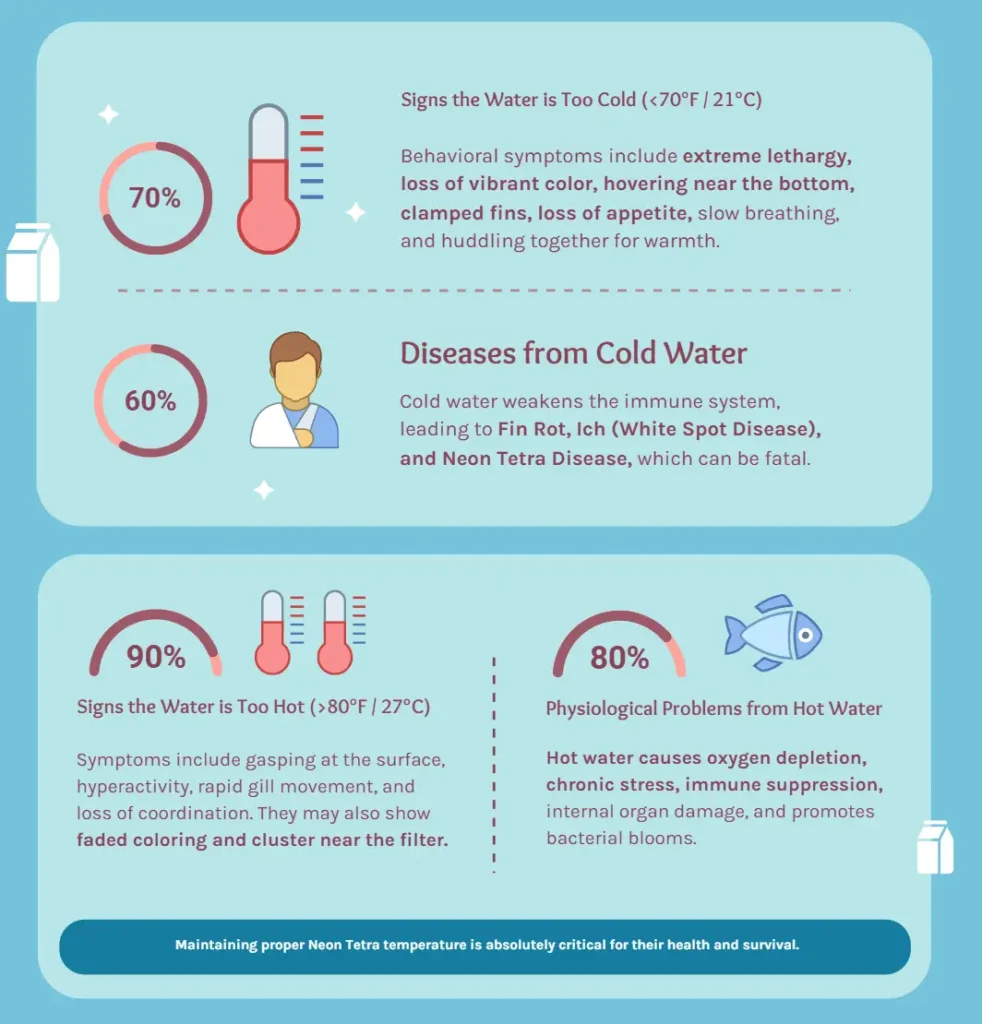
Signs the Water is Too Cold (<70°F / 21°C)
When Neon Tetras experience water temperatures below their comfort range, their bodies simply cannot function properly. Cold water is particularly devastating – temperatures below 60°F (15°C) will put tetras into shock and almost certainly result in death or permanent debilitation.
Even “cool” temperatures between 60-70°F (15-21°C) create serious problems. Exposure to these temperatures slows your Neon Tetra’s metabolism dramatically, affecting digestion, breathing, and all bodily functions.
Behavioral Symptoms of Cold Water:
- Extreme lethargy – fish barely move, rest on bottom constantly
- Loss of vibrant coloring – the brilliant blue and red fade to dull gray
- Hovering near the bottom – staying in one spot, minimal swimming
- Clamped fins – fins held tight against body instead of flowing naturally
- Loss of appetite – refusing all food, even favorite treats
- Slow, labored breathing – reduced gill movement
- Huddling together – seeking warmth from other fish
Diseases Amplified or Caused by Cold Water:
- Fin Rot betta: A bacterial infection that can prove fatal if untreated. Fins first change color (usually darkening or showing red inflammation), and if left untreated, begin deteriorating and falling off entirely. Cold water creates the perfect conditions for the bacteria to flourish.
- Ich (White Spot Disease): A parasitic infection that causes devastating damage to fish gills and skin. The parasite thrives in cold, stressful conditions and appears as white spots covering the fish’s body. (Wondering whether your fish can survive ich without treatment? Early intervention is critical.)
- Neon Tetra Disease: While not directly caused by cool water, this parasitic disease capitalizes mercilessly on the weakened immune system cold water creates. The parasite attacks and progressively weakens muscle tissue, becoming increasingly potent over time. This disease is particularly devastating to Neon Tetras specifically.
Obviously, none of these outcomes are acceptable, which underscores why maintaining proper Neon Tetra temperature is absolutely critical.
Signs the Water is Too Hot (>80°F / 27°C)
While Neon Tetras show slightly more resilience to warmer temperatures than cold (being tropical fish), excessively hot water creates equally devastating effects. Water above 78°F (26°C) begins causing problems, and temperatures reaching 90°F (32°C) become rapidly fatal.
Behavioral Symptoms of Hot Water:
- Gasping at the surface – frantically trying to breathe from surface air
- Extreme hyperactivity – darting erratically, unable to rest
- Rapid gill movement – gills pumping much faster than normal
- Loss of coordination – swimming in unusual patterns, losing balance
- Faded coloring – stress causes color loss
- Clustering near filter output – seeking areas with better oxygenation
Physiological Problems from Hot Water:
- Oxygen Depletion and Suffocation: This represents the most immediate danger. Warm water holds significantly less dissolved oxygen than cool water. Simultaneously, elevated temperatures increase your Neon Tetra’s metabolism, causing hyperactivity that consumes oxygen faster. This creates a deadly double threat – less oxygen available precisely when fish need more. Tetras can literally suffocate in hot water despite having access to air at the surface.
- Chronic Stress and Immune Suppression: Neon Tetras are sensitive creatures, and sustained high temperatures cause severe stress and agitation. This stress weakens their immune system progressively, making them vulnerable to diseases and infections they would normally resist easily.
- Internal Organ Damage: At dangerously high temperatures, oxygen deprivation causes fish to become lethargic despite the heat, lose all appetite, and suffer potential organ failure. In extreme cases, prolonged heat exposure can cause internal organs to shut down, which proves rapidly fatal.
- Bacterial and Parasitic Blooms: Harmful bacteria and parasites thrive in warm water, reproducing rapidly. If conditions remain hot, these microorganisms can quickly overwhelm a tank, causing outbreaks of fin rot, swim bladder disease, and other serious illnesses affecting all tank inhabitants.
How Sudden Temperature Changes Affect Neon Tetras
The speed of temperature change matters as much as the temperature itself. If temperature adjustments become necessary or inevitable, the single most important thing you can do for your Neon Tetra is ensuring changes occur slowly and gradually.
Sudden temperature swings – even within the “safe” range – weaken immune systems through a combination of physiological stress and disrupted digestion. While this stress may be temporary, the damage it causes to their health can prove irreversible. A compromised immune system opens your tetras to ICH, bacterial infections, and parasitic diseases.
Temperature drops prove particularly devastating. When Neon Tetra temperatures plummet quickly – even briefly – fish are highly likely to enter shock. While not guaranteed fatal, shock typically causes debilitation that drastically shortens lifespan. Muscles weaken permanently, and fish undergo severe stress. Like most animals (but especially fish), stress functions like slow poison. Even small amounts create adverse health effects and shorten life expectancy.
Sudden temperature increases create problems too. The acute discomfort from rapid heating causes stress and may trigger physiological problems including organ stress and oxygen deprivation.
Golden Rule: Any necessary temperature changes should occur at a maximum rate of 2°F (1°C) per hour to minimize stress.
How to Maintain Temperature (Essential Equipment Guide)

Now that you understand the critical importance of stable temperature, let’s ensure you have the tools and knowledge to maintain perfect conditions consistently.
Choosing the Right Thermometer
One of the simplest yet most valuable investments you can make is acquiring a quality thermometer for your aquarium. This single tool detects even slight temperature changes, allowing you to respond before significant harm occurs to your tetras.
Several thermometer types exist, each with distinct advantages and price points. Here’s a comprehensive comparison to help you select what’s right for your situation:
Stick-On (LCD) Thermometers
Accuracy: Moderate (±2°F/1°C)
Price: $3-8
Best For: Budget-conscious beginners
While not the most accurate option available, LCD thermometers provide sufficient accuracy for general fishkeeping. They’re among the cheapest options and are most commonly used in freshwater aquariums. If you want reliable, inexpensive, and user-friendly temperature monitoring, LCD thermometers may suit your needs.
Pros: Very affordable, easy to read, no batteries required
Cons: Reads tank glass temperature (not actual water), can be affected by room temperature, less accurate
Floating/Submersible Glass Thermometers
Accuracy: Good (±1°F/0.5°C)
Price: $5-12
Best For: General aquarium use
These thermometers are designed for full immersion in aquarium water, providing more direct and accurate readings than stick-on varieties. While accurate, they still don’t match digital precision. They’re relatively inexpensive and reliable.
Pros: Measures actual water temperature, reasonably accurate, affordable
Cons: Can break (glass), may be moved by strong currents, no temperature alerts
Digital Thermometers (Recommended)
Accuracy: Excellent (±0.5°F/0.3°C)
Price: $15-40
Best For: Serious aquarists, breeding setups, valuable fish
Definitely the most expensive option, but the advantages often justify the investment. The biggest benefit: most digital thermometers include programmable temperature alerts that notify you immediately if water temperature rises or falls outside your set range.
This alert feature represents a genuine game-changer and can mean the difference between life and death in emergencies like heater failures, power outages, or equipment malfunctions.
Pros: Highly accurate, temperature alerts, easy to read displays, some include wireless monitoring
Cons: Most expensive option, requires batteries, more complex setup
Which thermometer you ultimately choose depends on your specific needs, preferences, and budget. However, what’s most important is having at least one reliable thermometer to ensure your tank maintains correct temperature continuously.
How to Keep a Fish Tank Warm
As mentioned throughout this guide, keeping your Neon Tetra tank warm is vital for ensuring optimal health and providing the best breeding environment. Maintaining warmth might sound daunting, but here are four effective methods:
1. Use a Quality Aquarium Heater (Primary Method)
Invest in a high-quality aquarium heater that reliably regulates water temperature. Set it to your desired temperature – typically 75°F (24°C) for general care or 76-78°F (24-26°C) for breeding. This represents your primary, essential heating method that should always be in place.
2. Cover the Tank
Use an appropriate cover to trap heat inside the tank while simultaneously reducing evaporation. Glass lids work best – they’re durable, effective, versatile, and allow light penetration for plants. You can also create DIY covers using polycarbonate sheets.
Important: Whatever cover you use, ensure adequate gas exchange. Never seal the tank completely – fish need oxygen from surface air exchange. Leave small gaps or use covers with built-in ventilation.
3. Increase Room Temperature
Even without a heater (though this should only be temporary), you can maintain warmer tank temperatures by increasing room temperature. Keep the room housing your aquarium comfortably warm. This supplementary method helps heaters work more efficiently and provides backup warmth.
However, never rely solely on room heating – temperature drops at night or during air conditioning cycles will affect your tank.
4. Add Insulation to Your Tank
If your tank sits in a particularly cold room or during winter months, add insulation to the tank’s sides and back. Wrap the tank and all filtration equipment in blankets, towels, or even cardboard sheets. This supplementary insulation helps retain heat generated by your heater.
Note: Never insulate the front viewing panel – you need to observe your fish. Also, ensure insulation doesn’t block equipment ventilation or create fire hazards near electrical components.

Emergency: Keeping Your Tank Warm Without Electricity
Picture this emergency scenario: You’re enjoying a calm evening when suddenly your digital thermometer alert sounds. Checking the display, you discover your heater has completely failed and the temperature is dropping rapidly. Night is approaching, stores are closed, and you have no backup heater available. As room temperature falls, your tank water will plummet even faster.
Don’t panic. Here are proven temporary emergency measures to maintain warmth until you can obtain replacement equipment:
Immediate Emergency Actions:
- Cover the Tank Completely: Place a lid or secure cover over the top opening to trap all rising heat inside and prevent heat loss through evaporation. Even a towel laid across the top helps significantly.
- Insulate the Tank Exterior: Wrap thick blankets, towels, or even bubble wrap around the sides and back of the tank. Leave the front viewing panel exposed so you can monitor your fish. This insulation layer slows heat dissipation dramatically by creating a buffer against cold room air.
- Use Household Space Heaters Strategically: Position space heaters near (but not touching) the aquarium to warm the surrounding air. Raise the room temperature as high as comfortable. This increases ambient temperature around the tank and significantly slows cooling. Never place heaters in direct contact with the aquarium or any water.
- Float Sealed Containers of Warm Water: Fill clean plastic bottles or heavy-duty zip-lock bags with warm (not boiling) water and float them carefully in the tank. Replace these containers every 30-60 minutes as they cool. CRITICAL WARNING: NEVER pour hot water directly into your aquarium – this causes immediate thermal shock that can kill your fish instantly.
- Move the Tank to a Warmer Room: If possible and safe, carefully relocate the aquarium to the warmest room in your home. Basements and exterior walls are coldest; interior rooms or near (not on) heating vents are warmest.
- Reduce Water Surface Agitation: Lower filter output or turn off air stones temporarily. While oxygen is important, reducing surface movement decreases evaporative cooling. Monitor your fish closely for signs of oxygen deprivation (gasping at surface).
- Increase Tank Lighting: Aquarium lights generate modest heat. Leave them on longer than normal to provide supplementary warmth. However, don’t leave lights on 24/7 for more than a day or two as this stresses fish.
- Add Styrofoam Under the Tank: If your tank sits on a cold surface (concrete, tile, exterior wall), place styrofoam sheets or thick blankets underneath to prevent heat loss through the bottom.
⚠️ CRITICAL WARNING: These are temporary emergency measures ONLY. You must obtain a replacement heater within 24 hours maximum. Extended periods without proper heating will weaken immune systems, stress your Neon Tetras severely, and likely result in illness or death.
What NOT to Do in Heating Emergencies:
- ❌ Never add boiling or very hot water directly to the tank – instant thermal shock kills fish
- ❌ Never use hair dryers or heat guns on the tank – uneven heating and electrical hazards
- ❌ Never place the tank directly on or against heating sources – risk of cracking glass and fire hazards
- ❌ Never use chemical hand warmers in the water – toxic chemicals leak into water
- ❌ Never ignore the problem hoping it resolves itself – temperature drops kill quickly
Monitoring During Emergency Heating:
Check temperature every 30 minutes during emergency heating. Your goal is maintaining temperature above 70°F (21°C) minimum, ideally keeping it as close to 72°F (22°C) as possible. Watch your fish closely for signs of stress:
- Gasping at the surface (too hot or oxygen depletion)
- Lethargy and color fading (too cold)
- Erratic swimming (rapid temperature changes)
- Hiding and refusing to move (extreme stress)
Prevention: Never Face This Emergency
Heater failures represent one of the most common and preventable aquarium emergencies. Smart aquarists prepare proactively rather than react desperately:
- Always keep a backup heater: Store an appropriate spare heater for your tank size. Even an inexpensive backup is better than none.
- Install dual heaters in larger tanks: In aquariums 20+ gallons, use two smaller heaters instead of one large unit. If one fails, the other maintains some warmth until you can replace the failed unit. Two 50-watt heaters are better than one 100-watt heater.
- Invest in battery backup power: A UPS (Uninterruptible Power Supply) keeps essential equipment running during power outages. Even a basic model provides 30-60 minutes of power for heaters and filters.
- Use digital thermometers with audible alerts: These provide early warning of equipment failure, often catching problems before they become critical.
- Conduct monthly equipment inspections: Check heaters for cracks, mineral deposits, corrosion, or any signs of malfunction. Replace questionable heaters before they fail.
- Keep emergency supplies ready: Maintain a kit with plastic bottles, zip-lock bags, extra blankets, and a portable space heater specifically for aquarium emergencies.
The modest investment in backup equipment and emergency supplies pays enormous dividends when equipment fails. Your Neon Tetras’ lives may depend on your preparedness.
Frequently Asked Questions
What Is the Best Temperature for Neon Tetra Breeding?
To induce spawning, you should raise the water temperature slightly higher than their typical daily range. The ideal breeding temperature for Neon Tetras is between 75°F and 78°F (24°C – 26°C). It is vital to keep this stable; fluctuations can stress the fish and cause them to eat their own eggs. Additionally, maintaining soft water with a neutral to slightly acidic pH is just as important as the heat for successful breeding.
Can Neon Tetras Live in Cold Water?
No, Neon Tetras cannot survive long-term in cold water. Being native to the tropical Amazon Basin, they are genetically adapted to warm climates. While they might survive a short period in temperatures as low as 60°F (15°C), their immune system will shut down, leaving them vulnerable to Rot, Ich, and Neon Tetra Disease. Temperatures below 50°F (10°C) are rapidly fatal.
Is It Safe to Put Ice Cubes in the Tank During Summer?
You should never put ice cubes directly into the water. If a fish swims up and touches the ice, the extreme localized cold can cause thermal shock or burns on their skin.
Instead, place ice cubes inside a sealed Ziploc bag and float the bag on the water’s surface. This cools the water slowly and safely without risking direct contact with your Tetras.
Is 80°F (27°C) Too Hot for Neon Tetras?
Yes, 80°F is generally considered the upper limit for Neon Tetras. While they can survive it, high heat speeds up their metabolism, which shortens their lifespan and forces them to consume more oxygen. If your tank stays at 80°F or higher consistently, you must add an air stone to increase aeration, as warm water holds less oxygen than cool water.
Conclusion: Temperature Management is Non-Negotiable
Getting the temperature right is the single most effective way to keep your Neon Tetras vibrant and active for years to come. Because these fish are so small, they lack the body mass to retain heat, making them completely reliant on the environment you provide.
To recap, aim for a steady range of 72°F to 78°F (22°C – 26°C). The most critical tool in your arsenal is not just the heater, but a reliable thermometer to double-check that heater’s accuracy. By avoiding sudden fluctuations and keeping the water stable, you protect your school from stress and disease, ensuring they remain the jewel of your aquarium.
About the author

Hi it’s currently 31*C here and tank is getting to warm. What is best way to cool a tank? It’s going to be warm for few days.
Hey Luke,
You can actually get fans that sit on the top of your tank and blow over the water to keep it cool. Or a regular desk fan can do the same job. Also try to keep your tank out of direct sunlight