

Last Updated on 2026-09-25
None. Absolutely no fish can live safely or humanely with a betta in a 2.5-gallon tank. This small volume of water is not even considered adequate for a betta alone, let alone with tank mates. Adding any other fish will lead to extreme stress from territorial aggression, dangerously poor water quality from the increased bioload, and will ultimately harm both the betta and the new fish.
The Core Problems at a Glance
- Severe Lack of Space: Not enough room for two territories
- Toxic Water: Waste builds up too quickly (high bioload)
- Guaranteed Aggression: Confined spaces trigger a betta’s territorial nature
- Expert Recommendation: A 5-gallon tank is the absolute minimum for a betta alone
Fish Commonly (and Dangerously) Recommended for 2.5 Gallons—And Why to Avoid Them
Many beginner betta owners encounter well-intentioned but harmful advice about tank mates. Let’s address the most common suggestions and explain why they’re inappropriate for a 2.5-gallon setup.
Neon Tetras and Other Small Tetras
You might think small tetras are a good fit for a small tank, but this logic is dangerously flawed. Neon tetras are schooling fish that need to be in groups of 6 or more. Keeping a school of neon tetras requires at least a 10-gallon tank, and more realistically, a 15 or 20-gallon long setup.
In a 2.5-gallon tank, neon tetras would be severely stressed and unable to exhibit natural schooling behavior. Stressed fish become nippy and aggressive, which would trigger your betta’s predatory instincts. Additionally, six tetras would rapidly overwhelm the filtration system, creating toxic water conditions.
Guppies
Guppies are often recommended as “peaceful” tank mates, but this advice reveals a fundamental misunderstanding of betta behavior. Guppies’ long, colorful fins are a major trigger for betta aggression. A male betta will almost certainly perceive a guppy as a rival male and attack it relentlessly.
In a confined 2.5-gallon space, there’s nowhere for the guppy to escape. Your betta will pursue and harass the guppy until it’s injured or killed. Even if the guppy survives, the constant stress will suppress its immune system, leading to disease.
Corydoras Catfish
Corydoras are bottom-dwelling fish that many people assume are compatible with bettas because they occupy different tank zones. This is a critical mistake. Corydoras Catfish are also schooling fish that require groups and need far more floor space than a 2.5-gallon tank can provide.
These catfish have a high bioload—they produce significant waste as they scavenge the bottom. Adding them to an already-cramped 2.5-gallon tank would quickly create ammonia and nitrite spikes. The water quality would become toxic within days, endangering both species.
Otocinclus Catfish (“Otos”)
Otocinclus catfish are small and seem like they should fit in a tiny tank, but they’re actually quite demanding. Otos are sensitive fish that need pristine water conditions and a stable environment with plenty of algae to graze on.
A 2.5-gallon tank is far too unstable for these delicate fish. Water parameters fluctuate rapidly in small volumes, and the limited algae growth means you’d struggle to provide adequate food. Otos would starve or succumb to stress-related illness.
So, What Can Live in a 2.5-Gallon Tank? (Hint: Not a Betta)
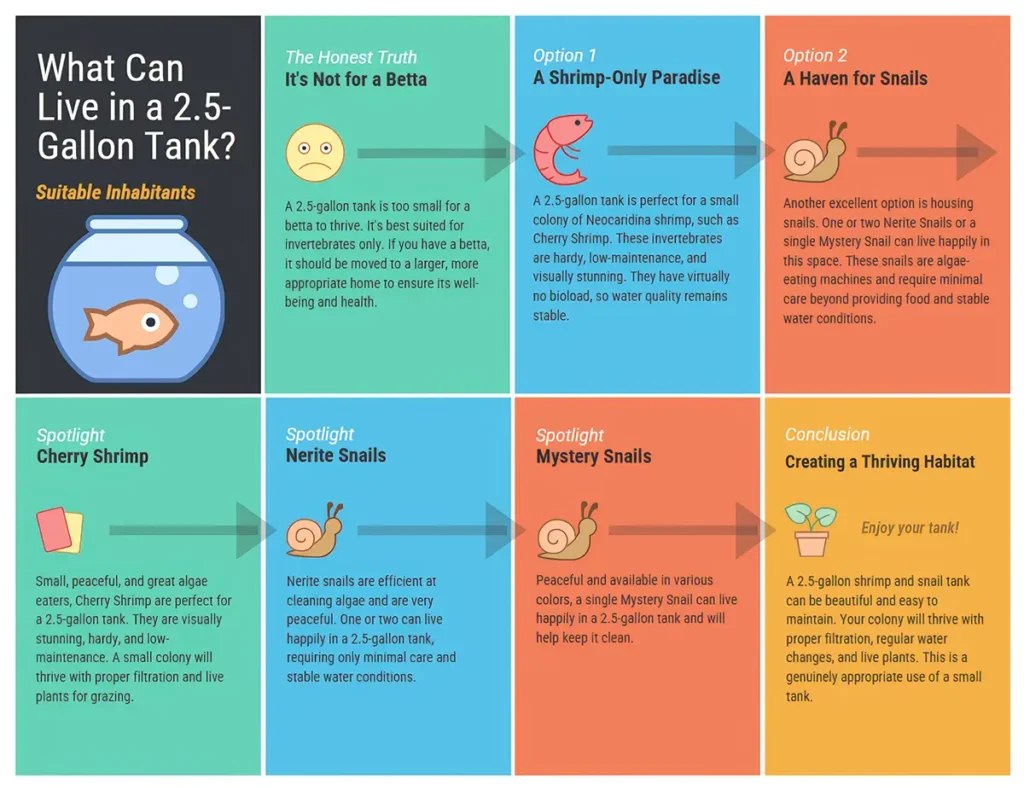
If you’re committed to using a 2.5-gallon tank, here’s the honest truth: it should house invertebrates only, and your betta should be moved to a larger, more appropriate home. A 2.5-gallon tank is simply too small for a betta to thrive, even alone.
A Shrimp-Only Paradise
A 2.5-gallon tank is actually perfect for a small colony of Neocaridina shrimp, such as Cherry Shrimp. These invertebrates are hardy, low-maintenance, and visually stunning. They have virtually no bioload compared to fish, so water quality remains stable. Cherry shrimp are also safe to keep together in groups, and they display fascinating scavenging and social behaviors.
Your shrimp colony would thrive with proper filtration, regular water changes, and some live plants for grazing. This is a genuinely appropriate use of a 2.5-gallon tank.
A Haven for Snails
Another excellent option is housing snails in your 2.5-gallon tank. One or two Nerite Snails or a single Mystery Snail can live happily in this space. These snails are algae-eating machines and require minimal care beyond providing food and stable water conditions.
Snails are peaceful, slow-moving, and won’t create conflict. A 2.5-gallon shrimp and snail tank can be beautiful and easy to maintain.
| Aquatic Creature | Description | Compatibility with 2.5-Gallon Tanks |
|---|---|---|
| Cherry Shrimp | Small, peaceful, and algae eaters | Suitable for 2.5-gallon tanks |
| Neocaridina Shrimp | Colorful, prefer similar tank conditions | Suitable for 2.5-gallon tanks |
| Ghost Shrimp | Small, easy to care for, non-aggressive | Suitable for 2.5-gallon tanks |
| Nerite Snails | Efficient at cleaning, peaceful | Suitable for 2.5-gallon tanks |
| Mystery Snails | Peaceful, come in various colors | Suitable for 2.5-gallon tanks |
| Ramshorn Snails | Help control algae, reproduce quickly if overfed | Suitable for 2.5-gallon tanks |
The Best Solution for Your Betta: Upgrade the Tank
While invertebrate-only setups are charming, if you specifically want a betta, you need to take a different approach. The solution is straightforward: upgrade to a larger tank.
The 5-Gallon Minimum for a Betta Alone
A 5-gallon tank is the widely accepted minimum for a betta to thrive and exhibit natural behaviors. Here’s why this matters:
Stable Water Conditions: A 5-gallon tank has enough water volume that temperature, pH, and ammonia levels fluctuate slowly. Your betta won’t experience the extreme stress that comes from rapid water parameter swings in a 2.5-gallon setup.
Space for Enrichment: With 5 gallons, you can include live plants, hiding spots, and surface area for your betta to build bubble nests. These environmental enrichments are crucial for mental health and stress reduction.
Proper Filtration: A 5-gallon tank can accommodate a gentle filter that maintains water quality without stressing your betta with strong currents.
Healthier, Longer Life: Bettas in properly sized 5-gallon tanks consistently show better coloration, higher activity levels, and longer lifespans than those in smaller enclosures.
The 10-Gallon+ Tank for Betta Tank Mates
If you want to keep fish with your betta, a 10-gallon tank is the absolute minimum, and even this requires careful species selection. A 20-gallon long tank is far more forgiving and provides the space each fish needs to establish its own territory.
In a properly sized tank, you have options like corydoras catfish, larger groups of peaceful tetras, or even certain types of plecos. However, this requires research, planning, and a commitment to excellent water quality management. Check out our guide on Betta Tank Mates for a full list of compatible species.
What Happens If You Add Another Fish Anyway?
It’s worth understanding the consequences of ignoring this advice, in case you’re tempted to take the risk.
Fighting and Injury: Your betta’s territorial instincts will activate. It will attack the other fish relentlessly, causing physical injuries, torn fins, and stress-related illness.
Ammonia Poisoning: Two fish in a 2.5-gallon tank produce more waste than the bioload the tank can handle. Nitrite and ammonia levels will spike to toxic levels, poisoning both animals.
Stress-Related Disease: The combination of aggression, poor water quality, and cramped conditions suppresses immune systems. Both fish become susceptible to fin rot, ick, and bacterial infections.
Premature Death: In the worst cases, one or both fish die within weeks. This is an unnecessary tragedy caused by inappropriate housing.
Frequently Asked Questions
Why is 5 gallons the minimum for a betta? A 5-gallon tank provides stable water conditions, room for enrichment, and enough space for a betta to exhibit natural behaviors like bubble nesting. Smaller tanks create stress and health problems.
Can I put a divider in a 2.5-gallon tank? No. Dividers make the problem worse, not better. Each side would be only 1.25 gallons—far too small even for a single betta. Your betta would be stressed by the confined space and unable to turn around properly.
What happens if I put another fish in anyway? Expect aggression, poor water quality, ammonia poisoning, stress-related disease, and likely death of one or both fish. It’s not a question of “if” something goes wrong—it’s “when.”
Are there any fish that can live in a tank smaller than 5 gallons? Generally, no. Some specialized nano fish exist, but they require expert-level care and sophisticated equipment. They are absolutely not suitable for beginners and should be avoided unless you have extensive aquarium experience.
The Bottom Line
Your desire to add companions to your betta is understandable, but a 2.5-gallon tank simply cannot support this. The most responsible choice is to upgrade to a 5-gallon tank for your betta alone, or use the 2.5-gallon for a shrimp and snail colony instead. If you eventually want tank mates for your betta, invest in a 10+ gallon tank with proper filtration and planning.
Your betta deserves a home where it can thrive, not merely survive. The small additional cost and effort of upgrading your tank is worth the improved health, behavior, and lifespan of your fish.
