
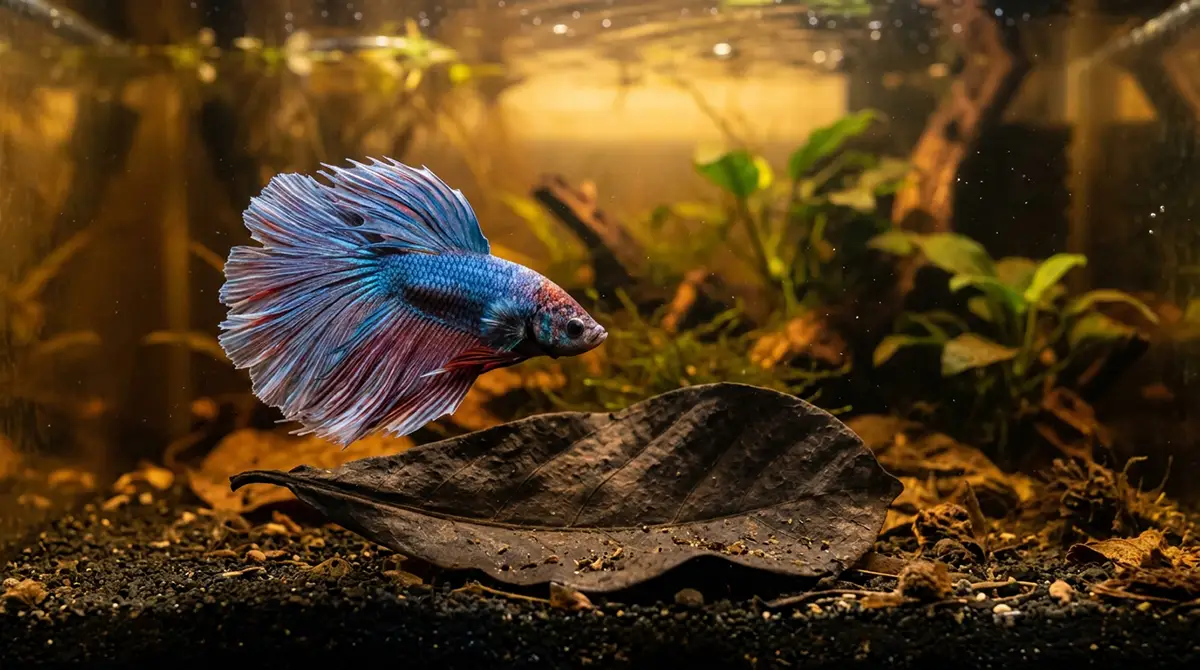
Key takeaways: Indian almond leaves recreate the soft, tannin-stained water bettas evolved in, and a 2018 study found their extract improved resistance to Aeromonas hydrophila in Betta sp. specifically. One leaf per 5 to 10 gallons is enough for most betta setups, replaced every 4 to 6 weeks.
A dried leaf floating in a five-gallon bowl does not look like much. Yet ask a keeper who has raised a splendens from rice-paddy stock, and they will tell you it changes more than the water’s color. Indian almond leaves sit at an odd intersection in the betta hobby, half folklore, half documented science.
Why bettas react differently to Indian almond leaves than other fish
Most articles treat Indian almond leaves for bettas as a subcategory of a broader aquarium topic. That framing misses something. Bettas are not incidental beneficiaries of catappa leaves, they are arguably the species the leaves suit best, for reasons rooted in where the fish actually comes from.
The native water bettas actually swim in
Betta splendens originates from the shallow, slow-moving waters of Thailand, Cambodia and parts of Malaysia: rice paddies, roadside drainage ditches, and forest-shaded streams. This is established by field studies on wild betta populations, not a hobbyist assumption. That water is rarely clear. It carries a constant load of decomposing leaf litter, runs soft, and sits at a pH often between 5.5 and 6.5. A betta kept in crystal-clear, alkaline tap water is not living in a “clean” environment by its own biological standard, it is living in an unfamiliar one.
Tannins, soft water and the betta’s biology
Tannins released by decomposing Indian almond leaves lower pH gradually and add humic and fulvic acids to the water. Bettas, thanks to their labyrinth organ, tolerate the low-oxygen, slightly acidic conditions typical of stagnant tropical water far better than most community fish. That physiological quirk is exactly why soft, tannin-rich water feels less like a treatment and more like a return to baseline for this particular species. I would go further: for a betta, tannic water is not an upgrade, it is closer to a correction.
What the research actually says about Indian almond leaves and betta health
Forums repeat the same claims about antifungal and antibacterial properties without ever naming a source. That habit is worth breaking here, because actual research exists, and some of it targets Betta specifically rather than fish in general.
The Aeromonas hydrophila study on Betta sp.
A 2018 study published in Veterinary World and archived on PubMed Central tested brown, naturally fallen Terminalia catappa leaf extract against Aeromonas hydrophila, a bacterium responsible for fin rot and septicemia in aquarium fish. The extract improved resistance to the pathogen in Betta sp. specifically, alongside benefits observed in tilapia and catfish (PMC, 2018). A broader review in Reviews in Aquaculture reached a similar conclusion across multiple farmed species: catappa extracts consistently reduced bacterial load and supported immune response (Wiley, 2024).
Where the science stops and the folklore begins
These trials used concentrated leaf extract, not a single dried leaf dropped into a home tank. The effect size in a five-gallon betta bowl is suspected to be milder, not identical to lab conditions, and no study has directly measured survival rates in home aquaria with whole leaves. What is established: tannins have measurable antibacterial activity against a pathogen relevant to bettas. What remains unknown: exactly how much protection a single decomposing leaf provides against everyday fin rot. My own read is that the leaf is a supportive layer, not a substitute for a heater set correctly and a filter that is actually cycled.
Fin rot, tail biting and long-finned betta varieties
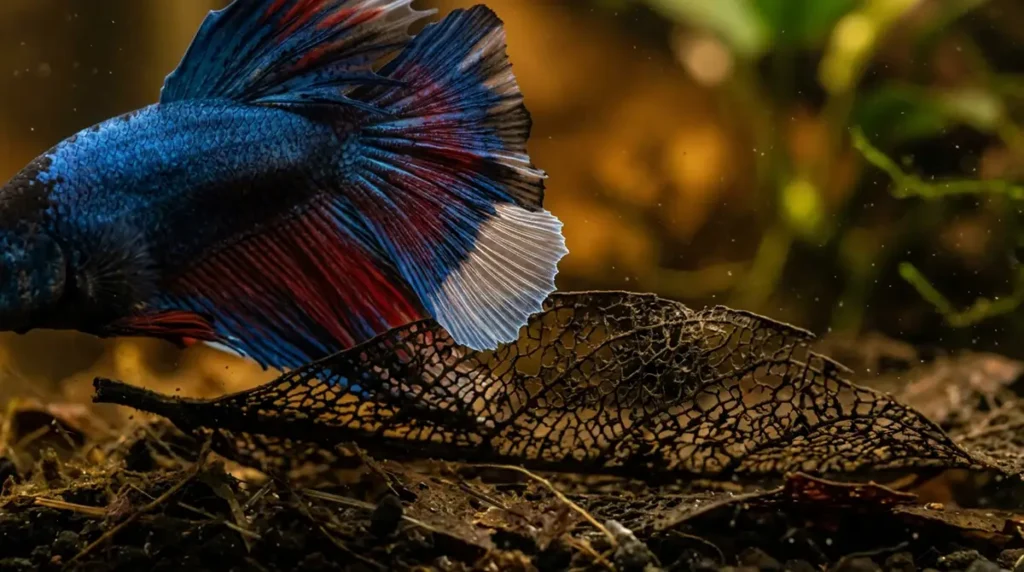
This is where Indian almond leaves for bettas earn their reputation among fancy-fin keepers. Halfmoon, veiltail and crowntail males carry fin surface area that a wild-type betta never evolved to drag around, and that extra tissue is more exposed to bacterial and fungal attack. Damaged fin edges heal slowly on their own. Owners who add a leaf after an aggressive flaring episode or a tail-biting phase often report the white, frayed margins stabilizing within one to two weeks, though this is observational rather than clinically measured. The tannins likely help by keeping bacterial pressure lower while the fin regrows, not by regenerating tissue directly.
Bubble nests and breeding: an overlooked use of Indian almond leaves for bettas
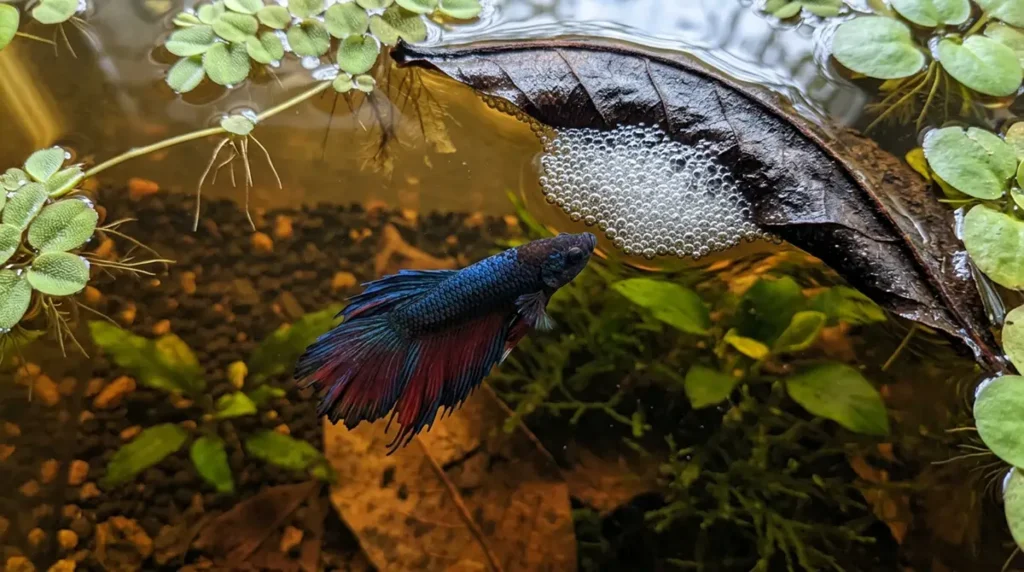
Male bettas build bubble nests at the surface before spawning, and a floating catappa leaf gives that structure something to anchor against, a detail wild-type breeders in Southeast Asia have relied on for generations before it reached Western fish rooms. The lower, more acidic pH the leaves produce also mirrors the water conditions that trigger spawning readiness in the wild. Breeders working with Apistogramma cichlids use catappa leaves for near-identical reasons, which says something about how consistently soft, tannic water signals “safe to breed” across unrelated species.
Calming a betta that flares at its own reflection
A betta that spends its day attacking its own reflection off the glass is not decorative aggression, it is chronic stress that shows up as clamped fins and reduced appetite. Tinted, tannin-stained water reduces glare and reflection sharpness enough that many keepers notice the flaring drop off within days of adding a leaf. Nobody has run a controlled trial on this specific behavior, so treat it as a plausible, widely reported side effect rather than a guaranteed fix. In my own tanks, it has worked more often than not, but I have also had one particularly stubborn male who flared at his reflection through leaf, plant cover and everything else I tried.
My own experience using Indian almond leaves with a halfmoon betta
A halfmoon male I kept a few years ago went through a rough patch of tail biting after I rearranged his five-gallon tank and he spent a week attacking his own tail edges out of stress. The fin margins turned pale and slightly ragged within days. I added half a medium leaf, kept up with twice-weekly 25% water changes, and swapped the leaf for a fresh half after three weeks. By day ten the fin edges had stopped fraying further, and new growth was visible by day eighteen. I cannot separate how much of that recovery came from the leaf versus the extra water changes I was already doing, and I think that honesty matters more than pretending the leaf alone did the work.
Dosage and setup: how much to use in a betta tank
Betta tanks run smaller than most community setups, which changes the math slightly from general aquarium advice. The full preparation method, including soaking and extract-making, is covered in detail on our dedicated Indian almond leaves guide, but here is what applies specifically to betta-sized housing.
| Betta setup | Leaf amount | Main purpose |
|---|---|---|
| 2.5-gallon bowl | Quarter to half a medium leaf | Mild pH softening, reduced glare |
| 5-gallon tank | Half a leaf | General water conditioning, fin support |
| 10-gallon community tank | One full leaf | Blackwater tint, stress reduction for tank mates |
| Breeding or spawning tank | One to two leaves, floating | Bubble nest support, pH drop for spawning readiness |
The steps below cover a first introduction into an established betta tank:
- Rinse the dried leaf briefly under lukewarm water to remove surface dust before adding it.
- Drop it in whole for a bowl or small tank, or weigh it down with a small pebble if the floating bothers you.
- Expect the water to shift toward a light amber shade within 48 to 72 hours.
- Replace the leaf once it turns skeletal and translucent, usually after four to six weeks.
- Watch pH over the first week if your tap water already sits below 7, since the drop can compound faster than expected.
For keepers building a fuller botanical setup around catappa leaves, our plants and botanicals section covers species that pair well with tannin-stained water, from anubias to java fern.
The one thing Indian almond leaves cannot fix
A leaf will not save a betta living in ammonia-poisoned, uncycled water, and I have seen keepers treat catappa leaves as a shortcut around basic maintenance. Tannins buffer, they do not purify. If fin rot keeps returning despite a leaf in the tank, the problem is almost always the filter, the tank size, or a heater set too low, not a missing leaf. My honest recommendation: fix the water chemistry first, then let the leaf do the smaller, supporting job it is actually suited for.
FAQ
Do Indian almond leaves cure fin rot in bettas?
No. They can support recovery through mild antibacterial tannins, but fin rot linked to bacterial infection or poor water quality needs a water change routine and, in severe cases, medication alongside the leaf.
How many Indian almond leaves does a betta tank need?
Half a medium leaf per 5 gallons covers most betta setups. Smaller bowls need only a quarter leaf to avoid overly dark, oxygen-thin water.
Can Indian almond leaves stop a betta from flaring at his reflection?
Often, yes, since the tannin tint reduces glass reflection. It is not guaranteed for every fish, and some bettas keep flaring regardless of water tint.
Is there real scientific proof Indian almond leaves help bettas?
A 2018 study found Terminalia catappa extract improved resistance to Aeromonas hydrophila in Betta sp. specifically, though results used concentrated extract rather than a single whole leaf.
Should I remove the leaf once my betta is breeding?
No, leave it floating. Males often anchor their bubble nest against it, and the slightly acidic water it creates supports spawning conditions.
