

Last Updated on 2026-07-06
If you’ve had your betta for a while at some point you’re going to ask yourself “can you put a betta fish with other fish?” Or perhaps you’ve already got a community tank and you’re thinking about adding a betta to it.
Whatever the reason, in this article you’re going to find out the times you can and can’t put a betta with other fish.
So keep reading to find out more.
Or Check out this video on keeping bettas in community tanks!
Key Takeaways:
- It is possible to keep Betta fish with other fish, but success depends on various factors.
- Avoid putting male Betta fish together to prevent fighting.
- Bettas may become aggressive when housed with brightly colored fish or fish with long, flowing tails.
- Select tank mates that occupy different areas of the tank, such as bottom-dwelling fish.
- Ensure the tank is appropriately sized, with a minimum of 10 gallons for Betta and compatible tank mates.
So Can Betta Fish Live With Other Fish?
It is possible to keep bettas with other fish. However, it won’t work in every scenario, and in some circumstances, your betta will prefer to live on their own. Unfortunately, there’s no way you’re going to know for sure until you give it a try.
Luckily, there are things you can do to minimize the chance of aggression from your betta.
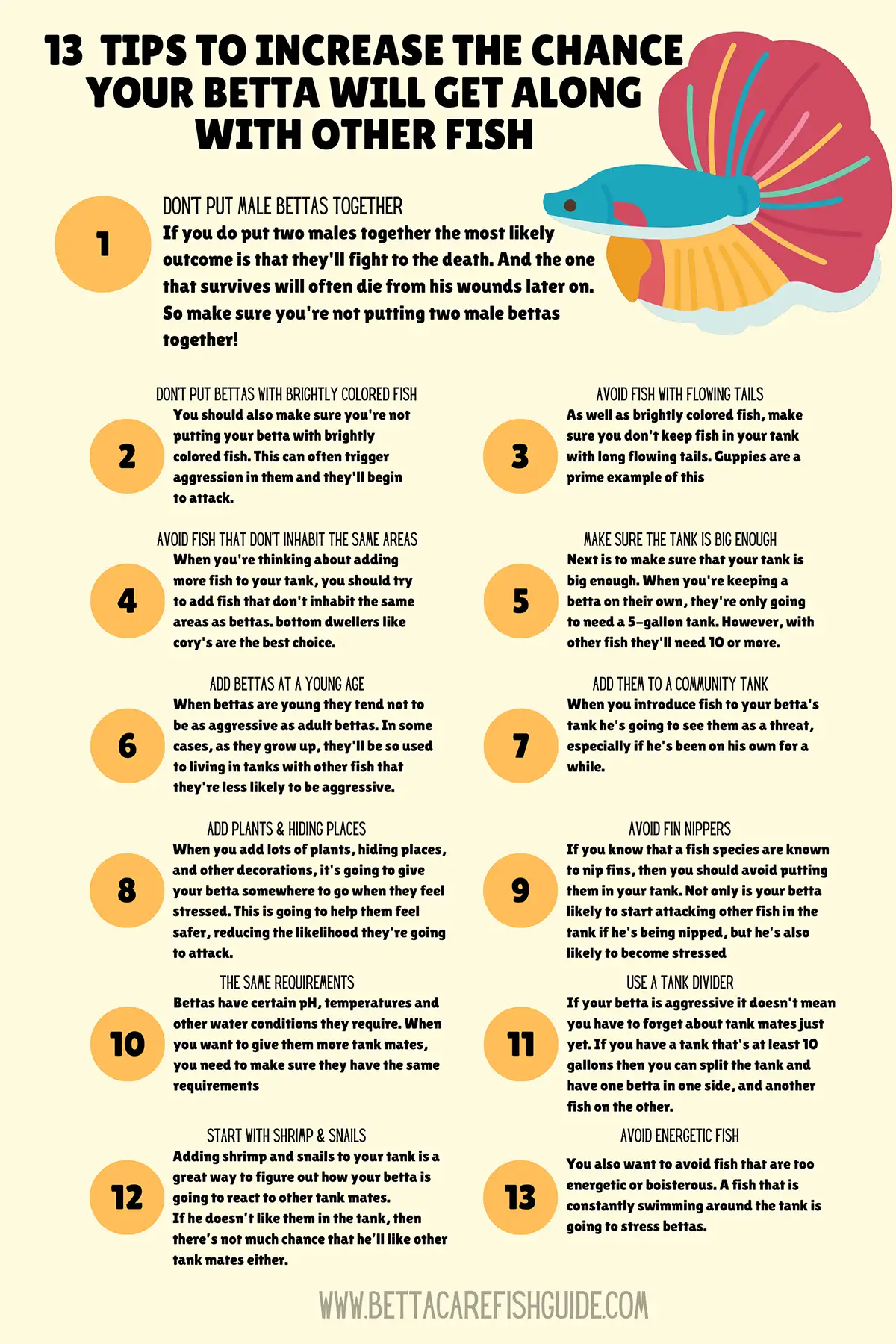
How To Increase The Chance Your Betta Will Get Along With Other Fish
If you’re going to add your betta with other fish, then you need to make sure they’re going to get along. Fortunately, there are ways you can increase the chances of this happening.
Here are some of the best ways to improve the chances.
1. Don’t Put Male Bettas Together
First of all, you should avoid putting males together. They’re called fighting fish for a reason, and if you put them together they’re going to do exactly that.
The only time this might not happen is if you put them in a big enough aquarium (150 Gallons+) which is densely planted. And even then there’s no guarantee they won’t end up fighting.
If you do put two males together the most likely outcome is that they’ll fight to the death. And the one that survives will often die from his wounds later on. So make sure you’re not putting two male bettas together!
2. Don’t Put Bettas With Brightly Colored Fish
You should also make sure you’re not putting your betta with brightly colored fish. This can often trigger aggression in them and they’ll begin to attack.
When you’re choosing fish it’s always best to pick dull looking fish like corydoras catfish. This way they’re going to ignore them as they’re not going to see them as a threat.
3. Avoid Fish With Flowing Tails
As well as brightly colored fish, make sure you don’t keep fish in your tank with long flowing tails.
A prime example of this are guppies. Guppies are extremely likely to be attacked by bettas, not just because of their tails, but their bright colors as well.
(Find out when you can keep guppies and bettas together.)
4. Buy Fish That Don’t Inhabit The Same Areas
When you’re thinking about adding more fish to your tank, you should try to add fish that don’t inhabit the same areas as bettas.
Your betta is going to inhabit the top and middle of the tank (but mainly the top) so if possible you should try to add bottom dwellers to the tank. Once again, corydoras catfish are a great choice.
As well as corydoras you could also try adding otocinclus catfish, glass catfish and if your tank is big enough, plecos as well!
(Remember, if your betta isn’t overly aggressive, you might be able to keep fish that live at the top or middle of the tank with him.)
5. Make Sure The Tank Is Big Enough
Next is to make sure that your tank is big enough. When you’re keeping a betta on their own, they’re only going to need a 5-gallon tank. However, when you want to house your betta with other fish, then you’re going to need a bigger tank.
The minimum tank size you should be going for is 10-gallons (Here are the best 10-gallon tanks). However, the size will change depending on the tank mate. For example, neon tetras are going to need at least 15 gallons.
6. Add Bettas At A Young Age
You could also try introducing their betta to other fish when they’re young.
When bettas are young they tend not to be as aggressive as adult bettas. In some cases, as they grow up, they’ll be so used to living in tanks with other fish that they’re less likely to be aggressive.
This is often one of the best ways to enable bettas to live with other fish, however, it always depends on the temperament of the fish.
7. Add Them To A Community Tank
When you introduce fish to your betta’s tank he’s going to see them as a threat, especially if he’s been on his own for a while. However, if you add your betta to a community tank, they may be less likely to attack as they won’t feel like any of it’s their own territory.
Instead of being aggressive, they might just find their own corner of the tank to claim as their own.
(If you’re not sure which fish your betta can live with here are 30 great tank mates. And if you want much more in-depth information check out the Ultimate Betta Tank Mate Guide. It talks about over 60 different tank mates for your betta, as well as how to care for them!)
8. Make Sure There Are Lots Of Plants & Hiding Places
Adding lots of plants and other hiding places is also going to make it more likely your betta will remain peaceful.
When you add lots of plants, hiding places, and other decorations, it’s going to give your betta somewhere to go when they feel stressed. This is going to help them feel safer, reducing the likelihood they’re going to attack.
As well as helping them feel safe, they’re also going to break lines of sight. If your betta can’t see the other fish, then they’re less likely to attack.
Lastly, giving your betta decorations, plants, etc is going to keep them entertained, so they’re less likely to become bored.
9. Don’t Buy Fin Nippers
There are certain fish that are known to be fin nippers. Some tetras and barbs are prime examples of this.
If you know that a fish species are known to nip fins, then you should avoid putting them in your tank.
Not only is your betta likely to start attacking other fish in the tank if he’s being nipped, but he’s also likely to become stressed, as well as there being an increased chance of fin rot occurring.
10. Start With Shrimp And Snails
Adding shrimp and snails to your tank is a great way to figure out how your betta is going to react to other tank mates.
If he doesn’t like them in the tank, then there’s not much chance that he’ll like other tank mates either.
When you’re starting out, try adding nerite snails. Once you know he doesn’t mind adding them to his tank, amano, ghost and cherry shrimp are great choices for your tank.
Once you’ve seen they’re not displaying aggressive behavior, you can try adding fish.
11. Make Sure The Tank Mates Have The Same Requirements
Bettas have certain pH, temperatures and other water conditions they require. When you want to give them more tank mates, you need to make sure they have the same requirements
If they don’t have the same requirements then the chances are one of the fish will die. And it’s not just fish you need to worry about.
Some plants can only survive in certain temperatures which may not necessarily meet your bettas needs.
12. Try Using A Tank Divider
If your betta is aggressive it doesn’t mean you have to forget about tank mates just yet. If you have a tank that’s at least 10 gallons then you can split the tank and have one betta in one side, and another fish on the other.
In fact, with this method, you’d even be able to house two male bettas like this if the divider is opaque.
13. Don’t Pick Energetic Fish
You also want to avoid fish that are too energetic or boisterous. A fish that is constantly swimming around the tank is going to stress bettas.
So when you’re picking fish try to go for ones that swim around slowly.
What Are Good Tank Mates For Bettas?
If you want to put your betta with other fish, then here are some great tank mates you should consider:
- Ember Tetras: Ember Tetras are small, fish that work great with bettas because of their neutral coloring and speed
- Harlequin Rasboras: You can also consider harlequin rasboras, just make sure you’re keeping enough space in your tank because thye need to shoal.
- Bronze Corydoras: These are my absolute favourite fish to put in a tank with bettas because they’re the complete opposite of what triggers aggression in a betta.
- Pygmy Corydoras: If you don’t have space for bronze corydoras, then why not try pygmy corydoras instead?
- Platies: Platies are so varied in the way they look and adding a few of them to your bettas tank can be a great addition!
- Kuhli Loaches: Kuhli loaches are calm peaceful tank mates that work great in any tanks, even ones with bettas!
- African Dwarf Frogs: Not the most popular choice of tank mate, African dwarf frogs can be a great addition to your bettas tank.
What Are Bad Tank Mates For Bettas?
There are also plenty of bad tank mates you can add with your betta as well.
If you’re keeping bettas, avoid putting other bettas in the tank, fin nippers, brightly colored fish, long tailed fish, and any fish that are too hectic in the tank.
Some bad tank mates for the tank include:
- Oscars
- Cichlids
- Gouramis
- Angelfish
- Bettas
- Tiger Barbs
How Do You Introduce Your Betta To Tank Mates
If you plan on introducing new tank mates to your betta there are a number of things you can do to increase the chance of success.
- Start with small tank mates like shrimp and snails to see how your betta will react.
- Once you know he’s comfortable with small tank mates, you can try introducing bigger ones.
- When you buy your new fish, place them in the tank with your betta, in a clear bag, so he can see them and get used to them.
- Let them get used to each while you acclimate your new fish to the tank.
- After 20-30 minutes, release the new fish into the tank. Make sure you keep the tank lights off so you can reduce the stress of all fish.
Keeping Female Bettas With Other Fish
Fortunately, female bettas are a little bit more tolerant than males. While the advice above is still worth remembering, you can be a little more lenient. For example, they’re not going to mind energetic fish as much as males. It’s also less likely that they’ll get their fins nipped as well.
However, with female bettas, it’s also important to note that they can be kept with their own kind on occasion.
Looking for a comprehensive guide about how to take care of your Betta fish? Click here!
Betta sororities are becoming more common, and in some cases, it’s also possible to keep a betta harem (1 male and a few females).
It is important to note that in both cases, it’s still going to depend entirely on the individual bettas’ attitudes.
(If you want to keep female betta fish, here’s everything you need to know about them!)
How Do You Feed A Betta In A Community Tank?
| Feeding Tips for Bettas in a Community Tank |
|---|
| Feed your Betta fish at one end of the tank, and other community fish at the opposite end to prevent aggression. |
| In extreme cases, you can catch your Betta in a net and place a pellet directly into the net with your Betta. |
| Make sure the tank lights are off when feeding to reduce stress for all fish. |
In a lot of cases, you can simply add the food to your tank and that will be enough to feed your betta. However, in some cases aggression may occur.
To stop aggression, you can try feeding your fish at one end of the tank, and your betta at the other. In extreme cases, you can try catching your betta in a net and place a pellet directly into the net with your betta.
How Long Does It Take For A Betta Fish To Adjust To A Community Tank?
Your betta should adjust to a community tank after a 4-5 days. However, if you added new fish to your bettas tank, he may not adjust. So try rearranging the decorations in the tank so it feels new to your betta.
FAQ
Do Betta Fish Need Tank Mates at All?
Actually, Bettas are quite happy living alone and don’t need any tank mates. In fact, it can be stressful for male Bettas to live with other fish, so if they show signs of discomfort, it’s best to create a tank of five gallons or more just for the one Betta.
Can Angelfish Live with Bettas?
It’s not recommended to keep angelfish with Bettas, as both species are very territorial and may fight, causing injuries, stress, and even death. Although there are some successful cases of Bettas and Angelfish living together, it’s best to avoid this combination.
Can Bettas Live with Guppies?
Guppies and Bettas can actually make great tank mates. However, it’s best to avoid fancy, long-finned guppies, as they may receive aggression from male Bettas. The more subdued feeder guppy relatives would be a better choice.
Recap
As you can see, you can keep your betta with other tank mates, and in fact, a lot of people do it quite successfully. However, if you are going to keep your betta with other tank mates, here are a few important things to remember.
- Make sure you don’t put males together.
- Don’t put brightly colored fish with your betta.
- Avoid fish with long flowing tails.
- Choose fish that don’t inhabit the same areas of the tank.
- Make sure the tank is big enough
- Add bettas when they’re juveniles.
- More success is normally found adding them to a community tank.
- Make sure there are lots of plants and hiding places.
- Don’t buy fin nippers.
- Start with shrimps and snails.
- Make sure tank mates have the same requirements.
- Try using a tank divider.
- And don’t pick energetic fish.
And when keeping females, in some cases it is possible to keep them in sororities, and in some rarer cases, you can also keep them in sororities.
Sources:
- https://www.aquariumcoop.com/blogs/aquarium/betta-tank-mates
- https://be.chewy.com/best-betta-fish-tank-mates/
About the author

i have three female bettas i a 6.5 tank. the new one has not eaten because the other baby and mature fish are pigs. what do i do
First of all, a 6.5 gallon tank is far too small for 3 females. You’ll need at least a 15 gallon but preferable 20 for them to live happily. The new one may not be eating due to stress from being in a tank that’s too small.You could try catching them in a net and adding food into the net, so that the other two can’t get to it. Hope this helps
I have a 10 gallon tank and i hav a gourami and two koi carps 2 inch sized so can i keep a male betta in my tank?
First, let’s clear up something essential: koi carp aren’t well-suited for a 10-gallon tank. These fish are pond animals that can grow over a foot long. So, even though they’re currently small, it’s just a temporary stage. They’ll soon outgrow your tank and could be stressed due to space limitations.
Gourami and Bettas
Gouramis and bettas are both territorial and may exhibit aggressive behavior towards each other. This isn’t ideal, especially in a small tank.